
Why I Joined DOGE
Why I chose to fight fraud in the heart of the federal government.

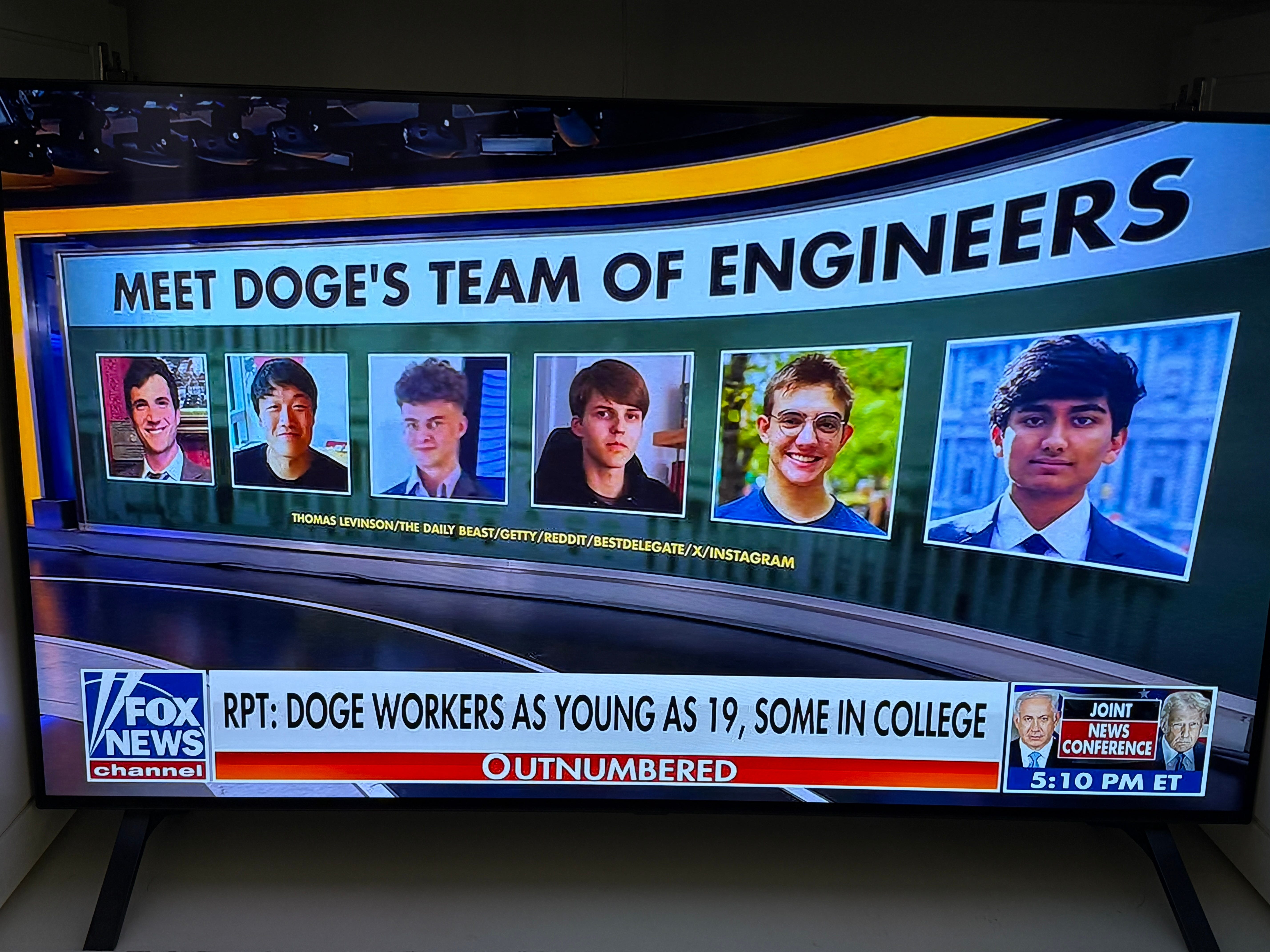
Author’s Note: This essay was originally published in February 2025 and covered widely, including by Business Insider. I took it down after receiving death threats following a Mother Jones piece that branded me antisemitic for citing a 2013 article in The American Conservative. The smear relied on associating me with work the author published years later, work I've never read. It was dishonest, and the people who wrote it knew it was dishonest.
I'm republishing now because I intend to write a series of posts documenting fraud schemes that steal taxpayer dollars. Before I do, I want readers to understand who's behind the reporting. Not a shadowy organization or a corporate media operation. Just a person, with a history and a point of view, who decided the work was worth doing despite the cost.
The Day I Stopped Trusting the Model
In the fall of 2016, I sat in a circle of the smartest kids I knew, watching them get something obviously wrong. It was the first time I realized that intelligence and independence are not the same thing. It would not be the last.
We were Math Circle students—the ones who found beauty in proofs, who believed numbers were incorruptible. That week, we’d gathered to analyze FiveThirtyEight’s election forecast. The model gave Hillary Clinton a 71.4% chance of victory, built on polling data, economic indicators, and historical trends. My classmates accepted it as near-certainty.
But something was off. Polling relied on people answering their phones and telling strangers who they planned to vote for. I didn’t know a single Trump supporter who would do either. The selection bias seemed obvious. I said so.
The room went quiet. Not the curious silence that invites debate, but the kind that signals you’ve crossed an invisible line. Then: “You just don’t understand the model.”
I understood the model fine. What I was learning was something else: intelligence doesn’t guarantee independence. These were students who could solve differential equations in their sleep, but they couldn’t question a conclusion that felt socially dangerous. The model wasn’t just predicting an election. It was telling them what respectable people were supposed to believe.
A week later, Trump won. I didn’t feel vindicated. I felt uneasy. If the smartest people I knew could be this wrong about something this measurable, what else were they wrong about?
How I Got Here
I should back up. My political education started two years earlier, with an article I stumbled across as a high school freshman.
Ron Unz’s “Our American Pravda” in The American Conservative wasn’t about the usual partisan complaints.1 It documented something more systematic: a press that had buried major scandals for decades, not through outright lies but through strategic silence. Communist spies in the Roosevelt administration, exposed years after the fact. The fraudulent intelligence that launched the Iraq War. Financial crimes ignored until they collapsed the economy.
I was fifteen. I’d assumed newspapers basically told you what happened. This piece suggested they told you what to think about what happened—and more importantly, what not to think about at all.
At the time, I filed it away as an interesting corrective. It wasn’t until the election, watching my peers treat a probabilistic model as scripture, that I understood the deeper pattern. The most effective manipulation isn’t the obvious lie. It’s the frame that makes certain questions unaskable.
Berkeley, August 2017
High school had taught me that smart people could be cowards. College would teach me that institutions could be complicit.
I arrived at UC Berkeley to study Electrical Engineering and Computer Science still half-believing that universities were places where you could say unpopular things and survive. The campus had been the birthplace of the Free Speech Movement. Surely some of that DNA remained. It took one week from orientation day to disabuse me of this notion.
On August 27th, at Martin Luther King Jr. Civic Center Park, I watched a group of black-clad Antifa members swarm a man and beat him to the ground. A few yards away, another group cornered someone in an American flag hoodie. One attacker swung a bike lock. Blood ran from the man’s nose. The police stood in formation nearby. They didn’t intervene.
Later, I learned they had orders not to.
That night, someone threw a burning generator through the glass walls of the student union. I stayed in my dorm, listening to sirens, processing what I’d seen. This wasn’t protest. It was permitted violence. And the permission came from the top.
The Washington Post’s coverage was telling. They described “about 100 anarchists and Antifa members” who “barreled into” the rally, “in some cases pepper-spraying and chasing” right-wing activists, “or beating them.” The passive construction did a lot of work. Beating them. As though it just sort of happened, like weather.
What followed was more instructive than the riot itself. Berkeley’s mayor urged the university to cancel upcoming conservative speakers—not because they’d broken any rules, but because the rioters might return. The chancellor expressed concern that cancellations would “collude in the narrative that universities are not open to all speech.”
Notice what she was worried about: the narrative. Not the students who’d been beaten. Not the firebombed building. The story people might tell about it.
This is how institutions die. Not through dramatic confrontation but through a thousand small accommodations. The rioters learned that violence worked. The university learned that it was easier to cancel Republican speakers than to protect them. The police learned that their job was to watch. And conservative students like me learned that our safety depended on keeping our politics invisible.
People’s Park
A few blocks from my dorm sat another object lesson in progressive governance.
People’s Park wasn’t really a park. It was an abandoned lot the university had planned to develop decades earlier but never got around to. By the time I arrived, it had become an open-air encampment—tents, needles, occasional violence. We got crime bulletins regularly. Stabbings. Beatings. One night I heard gunshots. Someone died.
In 2018, the university finally announced plans to build housing there: 1,100 units for students, plus supportive housing for homeless residents. In a city where students paid outrageous rents for cramped apartments, this seemed like obvious good sense.
A few dozen liberal activists disagreed. They chained themselves to trees, filed lawsuits claiming the university's environmental impact report had failed to account for "social noise"—the potential disturbance from future student residents having parties—and physically blocked construction equipment. An appeals court actually agreed, ruling that the noise of undergraduates going about their lives constituted an environmental impact under California law. For years, they succeeded in stopping the project entirely. It took an act of the state legislature and a California Supreme Court ruling to finally clear the way.
I want to be precise about what happened here. A handful of liberal activists, through a combination of direct action and legal obstruction, prevented housing from being built in one of the most expensive college towns in America. The city and university, faced with determined opposition, chose paralysis over confrontation. Meanwhile, students kept paying impossible rents, and homeless men kept living in squalor a few hundred yards from lecture halls.
The activists claimed to care about the homeless. But the status quo they fought to preserve left those same people sleeping in filth, cycling through emergency rooms, dying in the open. The proposed development would have provided actual housing for some of them. The activists preferred symbolic purity to material improvement.
This is the essence of liberal governance: a process so paralyzed by bureaucracy and regulation, so terrified of offending its activist class, that it would rather let students bleed in the streets than risk upsetting the mob. A government that sees its own constituents as the enemy, that will bend over backward to accommodate vagrants and criminals while treating taxpayers and students as interlopers in their own city.
COVID and the Death of “Trust the Science”
Berkeley was a local failure. COVID revealed that the rot went all the way to the top.
When the pandemic hit, I expected the institutions I’d learned to distrust on political matters to at least get the technical stuff right. Public health was supposed to be different: empirical, evidence-based, insulated from ideology.
I was wrong about that too.
“Two weeks to slow the spread” became months of lockdowns. Small businesses were shuttered while Amazon and Walmart raked in billions. Restaurants had to close indoor dining, then outdoor dining, then reconfigure entirely for “safety.” Churches were shut down. Liquor stores stayed open.
Vaccine mandates came next. First voluntary, then "strongly recommended," then mandatory with no exceptions. The Biden administration fired thousands of nurses, the same ones hailed as heroes months earlier, for declining the shot. Then, when staffing shortages got bad enough, COVID-positive nurses were allowed to keep working. Same virus, same science, different calculus. Meanwhile, study after study showed natural immunity provided strong protection, but acknowledging this was treated as heresy.
The politicians who imposed these rules didn’t follow them. Gavin Newsom dined at the French Laundry. Nancy Pelosi got her hair done. The mandates were for the governed, not the governors.
The worst decisions killed the most vulnerable. Governors like Andrew Cuomo forced COVID-positive patients into nursing homes, seeding the virus among the elderly who had no ability to isolate. They locked these people away from their families, denied them the dignity of human contact in their final days, and then claimed their policies saved lives.
The lockdowns were a net negative. They destroyed businesses, delayed children’s education, inflicted widespread psychological harm, and did little to stop a virus that was going to spread regardless. But the real lesson wasn’t epidemiological. It was political: the phrase “trust the science” had become a demand to trust whichever scientists held institutional power and to silence the ones who didn’t. That’s not science. It’s politics in a lab coat.
Control and Compliance
COVID showed Americans what their government could do when it decided the emergency justified the means. But my home state of California had been running the pilot program for years.
I own a number of firearms, including rifles, shotguns, and handguns. To own a legal semi-automatic rifle in California, you’re forced to neuter it into what’s called a “featureless” configuration. No standard magazines. No adjustable stocks. And if you want to avoid registering your rifle as an “assault weapon,” you need to replace the grip with something called a fin grip: a thin piece of plastic designed to prevent you from wrapping your thumb around the rifle. Apparently, holding your rifle comfortably is what transforms it into a weapon of mass destruction.
Criminals snap off the fin grip in seconds. Law-abiding gun owners are left with clunky, awkward rifles that are harder to use safely at the range. The result is a law that accomplishes nothing except making responsible gun owners less safe while doing nothing to deter actual crime.

This is the essence of progressive regulation: arbitrary restrictions designed not to improve safety but to enforce compliance. The rules aren't meant to solve problems. They're meant to remind you who's in charge. They're meant to create a permanent class of rule-followers, people trained to accept arbitrary power without question, people who will line up for whatever comes next.
The Government’s Priorities
If COVID showed that the government would abuse its power, the disasters that followed showed something worse: when Americans actually needed help, the government wasn't interested.
I visited Maui in 2021, before the fires reduced paradise to ash. Lahaina was alive then: historic Front Street bustling with life, the banyan tree stretching its roots deep into the earth, the scent of salt and fresh seafood in the air.
Then the fires came. Entire neighborhoods were incinerated in minutes. Children were trapped because roadblocks prevented their escape. Over 100 died, some never identified. And when survivors turned to the Biden administration for help, they got a one-time $700 payment, barely enough for a few nights in a motel. Meanwhile, FEMA officials stayed in luxury resorts and dined on taxpayer-funded meals.
The same pattern played out in North Carolina after Hurricane Helene. Entire towns underwater. Roads washed away, bridges collapsed, homes obliterated. Families fled to emergency shelters only to find them understocked and overwhelmed. Biden’s FEMA, slow to act, botched supply distribution and left storm victims waiting days for clean water. In many areas, private charities like the Cajun Navy did more to help than the federal government.
And while Americans waited, the Biden administration had other priorities. A floating pier in Gaza that broke apart and washed away. Endless unconditional aid to Ukraine. An Afghanistan withdrawal that left behind more military equipment than most nations possess. USAID spending billions on NGOs and foreign initiatives while citizens in Maui and North Carolina couldn’t get a callback.
Then there was the border. Over seven million illegal immigrants entered the country under Biden, more than the population of 36 individual states. The administration didn’t just fail to stop it. They facilitated it. They flew migrants into the interior of the country. They sued states that tried to enforce the law. They told us the border was secure while we watched, on live television, as thousands crossed every single day.
The federal deficit soared past $34 trillion, but when Americans needed help, they got scraps. The Biden administration had made its choice: billions for Ukraine, billions for foreign NGOs, open borders for the world, and $700 for the citizens of Lahaina. America last.
Why DOGE
People ask why I left a lucrative tech job for government work. The honest answer is that I spent a decade watching institutions fail and realized that complaining about it wasn’t enough.
The failures I've described aren't random. They share a common structure: systems that have grown so complex, so encrusted with process and captured by interest groups, that they can no longer perform their basic functions. Universities that can't protect free inquiry. Cities that can't build housing. Public health agencies that can't give straight answers. A federal government that, under Biden, sent billions to foreign NGOs while Americans wait weeks for disaster relief.
The Department of Government Efficiency is an attempt to do something about this. Not another blue-ribbon commission that issues a report and dissolves. An actual effort to identify which federal functions are redundant, which regulations create costs without benefits, which agencies have drifted from their missions, and which programs exist primarily to enrich contractors and foreign interests at taxpayer expense.
The corrupt, the criminal, the complacent, and the contemptible will fight this with everything they have. They will use every lever of power to preserve the status quo. They will lie. They will smear. They will threaten. I know this because they already have. They called me a Nazi. They put up posters of my face around D.C. They sent thousands of death threats to silence me. And they will do the same to anyone who threatens the machine that feeds them.
I have a message for them: We are not afraid of you. We are coming for the fraud. We are coming for the waste. We are coming for every dollar you’ve stolen from the American people while families in Maui slept in cars and veterans died waiting for care. You’ve had your run. It’s over.
And for those who think we’ll back down when the pressure mounts, I’ll let Reagan say it:
You and I know and do not believe that life is so dear and peace so sweet as to be purchased at the price of chains and slavery. If nothing in life is worth dying for, when did this begin—just in the face of this enemy? Or should Moses have told the children of Israel to live in slavery under the pharaohs? Should Christ have refused the cross? Should the patriots at Concord Bridge have thrown down their guns and refused to fire the shot heard ‘round the world? The martyrs of history were not fools, and our honored dead who gave their lives to stop the advance of the Nazis didn’t die in vain. Where, then, is the road to peace? Well it’s a simple answer after all. You and I have the courage to say to our enemies, “There is a price we will not pay.” “There is a point beyond which they must not advance.”
There is a point beyond which they must not advance. That point is here. That point is now.
The cost of joining DOGE was enormous. My stock grants alone were worth multiples of what I’ll make in government. But some things are worth more than money. Some fights are worth having even if you lose. And this one, we intend to win.
A Note to Anyone Feeling This
If you’ve read this far, you probably recognize some of what I’ve described. The moment you noticed something your peers couldn’t see. The social cost of saying it out loud. The slow realization that the institutions you trusted were performing competence rather than achieving it. The growing sense that something has gone deeply wrong, and that the people in charge either can’t see it or don’t care.
You’re not crazy. You’re not alone. And you’re not powerless.
I don’t have a tidy conclusion. The problems are real, the solutions are uncertain, and anyone who tells you otherwise is selling something. But uncertainty is not the same as helplessness.
The path from observation to action is shorter than it appears. If you have technical skills and a tolerance for bureaucracy, DOGE is hiring. If government work isn’t for you, there are other levers: local politics, journalism, building alternatives to captured institutions, or simply refusing to stay silent when you see something wrong.
The first step is just deciding that the gap between how things are and how they could be is worth trying to close. The second step is deciding that the people who benefit from the status quo don’t get to tell you to sit down and shut up.
From that, all else follows.
The author works with the Department of Government Efficiency. The views expressed are personal and do not reflect the official positions of DOGE or any other government entity.
A note on this reference: At the time of publication, Unz was publisher of The American Conservative, a mainstream publication whose contributors have included Andrew Bacevich, Daniel Larison, and Rod Dreher. In fact, the far-left leaning Atlantic wrote favorably about this particular article. I'm aware that Unz's later work has been controversial, and some have attempted to characterize my reference to this 2013 piece as an endorsement of views he expressed years afterward. It isn't. I'm citing an article that was widely discussed in respectable outlets at the time I read it.
From a Gen Z perspective, watching the government become more authoritarian and increasingly fixated on non-citizens can be frustrating. If anything, it should push people to get involved and participate, because that’s the only way outdated ideas and leadership actually change.
Great background information! Please see my DM regarding press ethics complaint.